
Vietnam
The Next Manufacturing Frontier in Southeast Asia
Vietnam has developed into one of Asia’s most dynamic manufacturing locations — and for European Mittelstand companies, this creates a market that is increasingly difficult to ignore. The World Bank expects the Vietnamese economy to grow by around 6.8% in 2026, following 8% growth in 2025. Manufacturing, exports and investment remain central drivers of this expansion.
A Manufacturing Base That Needs Better Technology
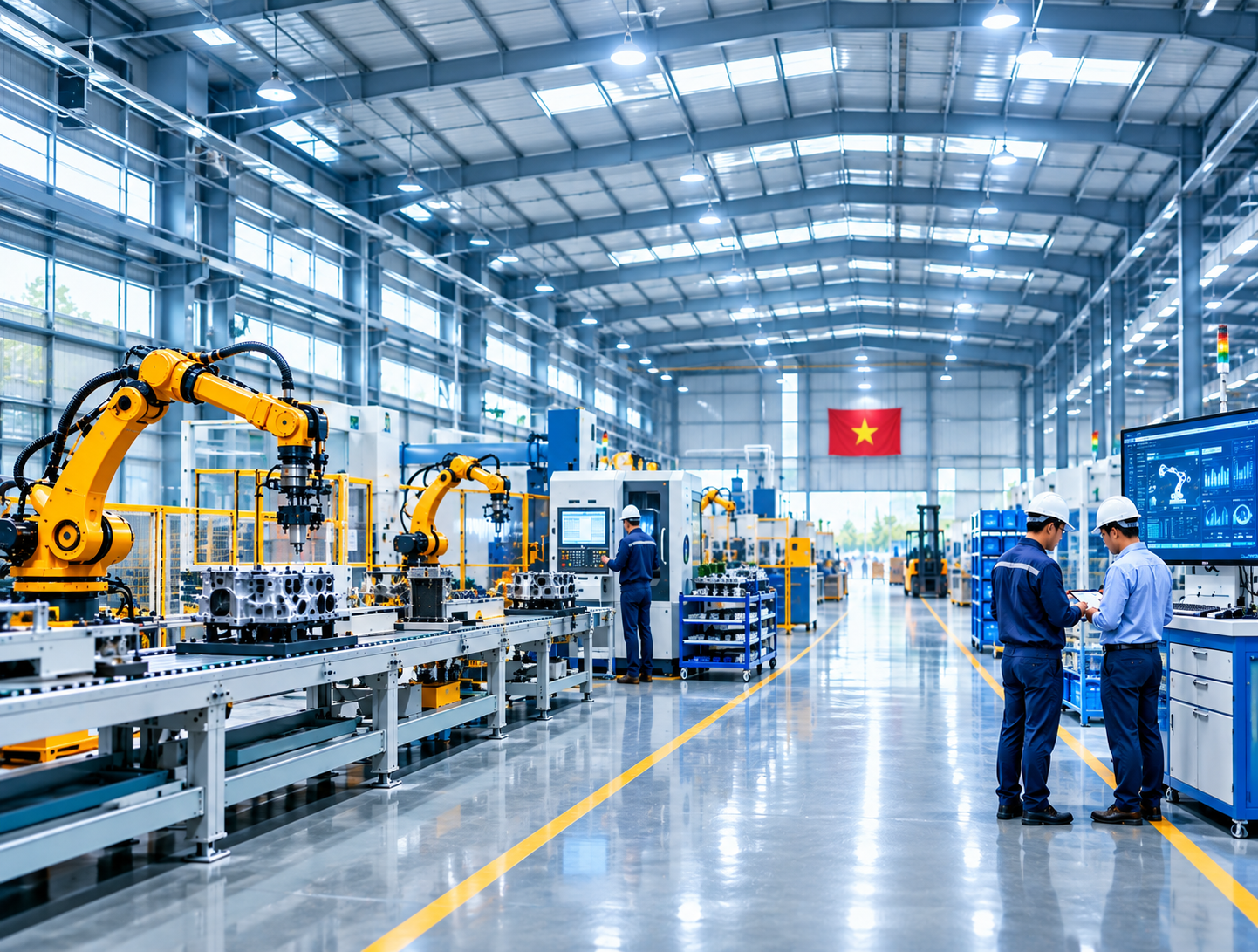
Vietnam is no longer simply a low-cost manufacturing destination. International manufacturers and their suppliers are continuously expanding local production, creating demand for modern machinery, engineered components, automation, process equipment and industrial services. Foreign investment actually implemented in Vietnam increased from US$17.5 billion in 2017 to US$25.4 billion in 2024, while Tier-2 and Tier-3 suppliers are increasingly following major manufacturers into the country.
This is precisely where German and Dutch Mittelstand companies can excel. Vietnamese manufacturers are under growing pressure to improve productivity, quality, energy efficiency, automation and reliability. European engineering can therefore compete on much more than purchase price: equipment lifetime, process know-how, efficiency and dependable after-sales support can become decisive differentiators.

Follow the Investment
Vietnam has become one of the principal beneficiaries of the diversification of Asian supply chains. Korean, Japanese, Taiwanese, Chinese, European and American manufacturers are building and expanding factories in the country. In 2025, manufacturing accounted for approximately 55% of announced foreign investment, illustrating how strongly industrial development remains at the heart of Vietnam’s growth story.
Every new factory creates another ecosystem of opportunities: production machinery, pumps, compressors, heat exchangers, process equipment, electrical systems, instrumentation, automation, environmental technologies, material handling, maintenance solutions and specialized engineering services.
European Engineering Has a Place in the Market
Vietnam is a competitive market, and European suppliers should not expect to win on price alone. Chinese and other Asian manufacturers are formidable competitors, particularly for standardized equipment. But the equation changes when reliability, precision, energy consumption, product quality or process performance matter. German machinery continues to enjoy a reputation for reliability in demanding Vietnamese applications, while recent market analysis identifies opportunities for German equipment and engineering suppliers as industries such as semiconductor manufacturing expand. For specialized Mittelstand manufacturers, that distinction is important: Vietnam does not have to be a mass market to become a highly attractive niche market.
A Gateway into Southeast Asia
Vietnam should also be viewed beyond its domestic market. Its export-oriented industrial base, extensive network of trade agreements and integration into regional supply chains make the country an attractive platform for reaching customers throughout Southeast Asia. The EU–Vietnam Free Trade Agreement (EVFTA) strengthens this connection with Europe. Combined with Vietnam’s growing industrial ecosystem, it makes the country particularly interesting for European manufacturers seeking a long-term position in ASEAN rather than occasional export sales. GTAI also highlights Vietnam’s network of free-trade agreements as an important advantage for companies manufacturing and operating from the country.
The Opportunity Is Local — So Your Sales
Presence Should Be Too
The opportunity is significant, but Vietnam is not a market that can easily be developed from a European headquarters alone. Industrial sales depend heavily on local relationships, regular customer contact, technical discussions, follow-up and trust. Identifying the right decision-makers and staying close to projects can make the difference between receiving an RFQ and never knowing the project existed. For Mittelstand companies that are not ready to establish their own Vietnamese subsidiary and sales organization, a local sales presence offers a pragmatic first step: develop the market, identify opportunities, build customer relationships and generate revenue before committing to a larger investment. Vietnam combines rapid industrialization with an increasing demand for precisely what European Mittelstand companies do best: specialized engineering, reliable technology and solutions that deliver measurable value over the long term. CliffEdge Strategies helps you turn that potential into business — with people on the ground, local market knowledge and a sales organization that acts as an extension of your own team.